Here are the results of our language competition in support of the Council of Europe's European Day of Languages on September 26.
All players who scored more than 500 points by September 30 received a FREE 1-month subscription to 10/31/2013 and the top scorers in each language were:
French
German
Italian
Spanish
Perfect Scores
638
695
544
673
1st Place: All with Perfect scores: FREE 1-year subscription
Arno, Carol, Evangeline, Luz, Serenity
Giovanni, Serenity
Carol, Serenity
Serenity, Sam, Carol
2nd Place: FREE 6-month subscription
Emily 634
Brad 687
Adina 536
David 651
3rd Place: FREE 2-month subscription
Anattolia 619
Vanessa 668
Claude 505
Selin 634
Congratulations to all the winners and runner-ups!
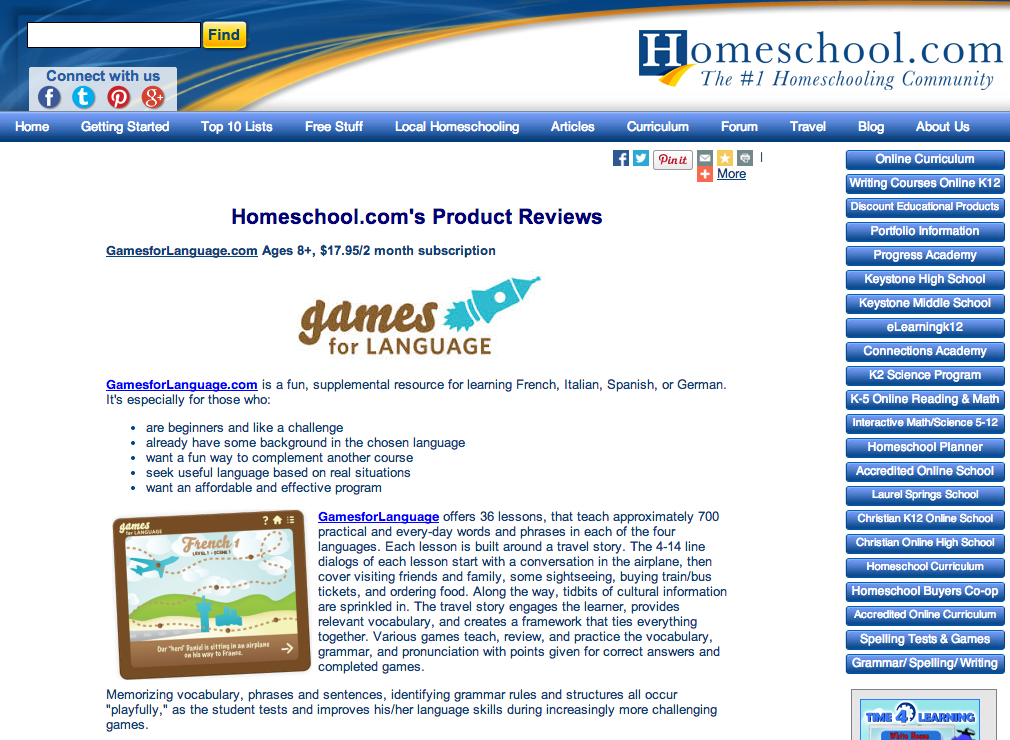
Homeschool.com, The #1 Homeschooling Community recently reviewed the GamesforLanguage.com program
They concluded:
“This is a fun language educational resource....it teaches relevant information....it's a game--so it's enjoyable....and it's very affordable--it's a great supplement for anyone learning French, Italian, Spanish, or German.
We certainly enjoyed Games for Language, and the games we played!”
We have recently been fielding inquiries from parents and camp counselors who wonder whether our GamesforLanguage programs are appropriate for homeschooling and summer camps. We always answer with an enthusiastic YES. In fact, our game-based programs are a great way to keep kids busy AND learning on rainy days. Once kids can read and write, they can play GamesforLanguage.
What are the GamesforLanguage program topics?
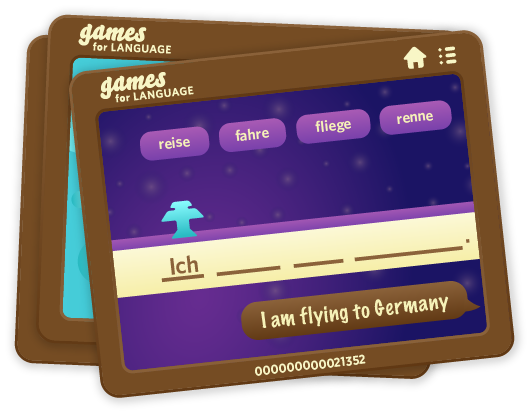
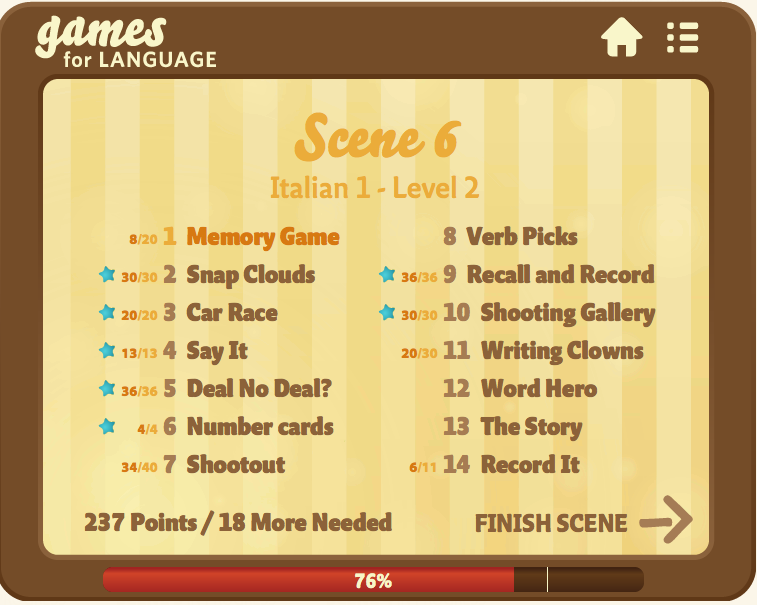
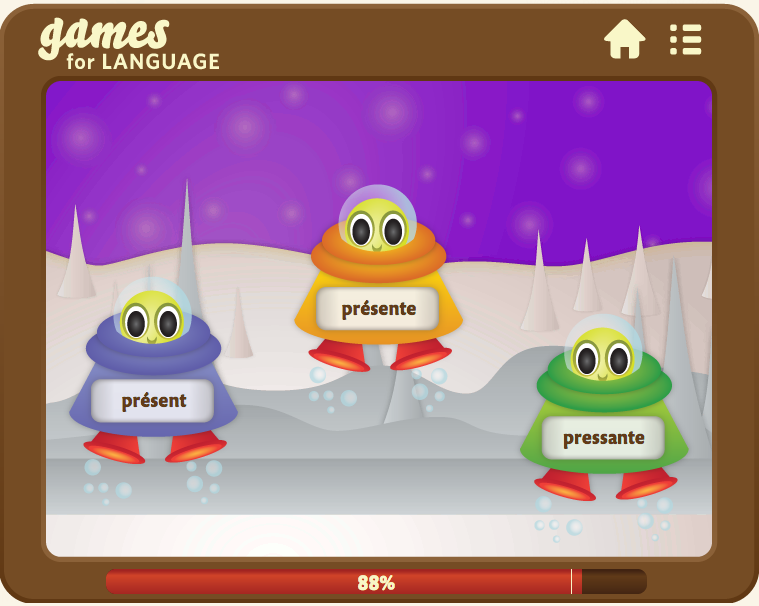
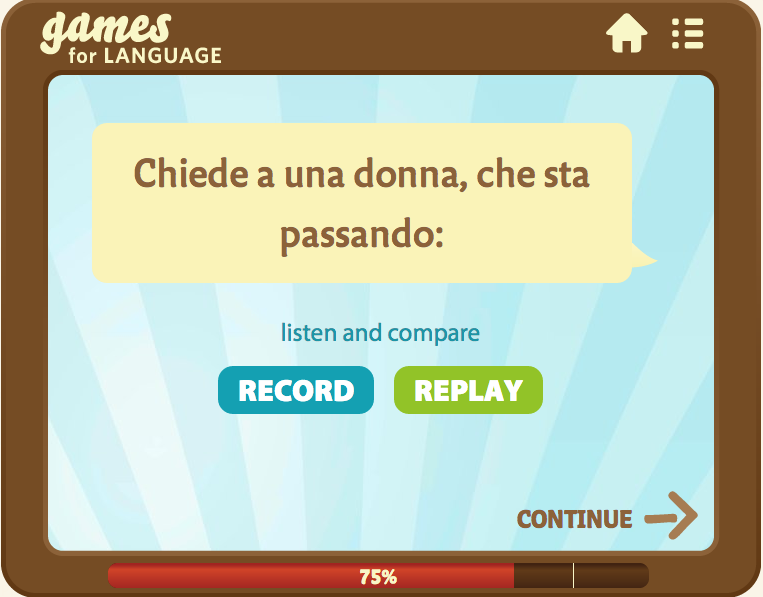
The 36 scenes of a course tell the story of a young man who travels to France, Italy, Spain, or Germany. The 4-14 line dialogs of each lesson – we call them “Scenes” - start with a conversation in the airplane, then cover visiting friends and family, some sightseeing, buying train/bus tickets, and ordering food. Along the way, tidbits of cultural information on each country are sprinkled in. (For example: Why did Mark Twain liked the name Heidelberg - where he lived for three months? Which French painter was a banker before he became famous?) The travel story engages the learner, provides relevant vocabulary, and creates a framework that ties everything together. Various games teach, review, and practice the vocabulary, grammar, and pronunciation with points given for correct answers and completed games. (For voice recording, the player needs a microphone and Flash Player.) After the first few Scenes, players have to reach minimum scores in order to progress to the next Scene.
How does GamesforLanguage.com work?
We described both the idea of our program and its specifics in two recent blogs: The GamesforLanguage Program – Part 1: Approach and Methods, and Part 2: Games Summary. Even if children are following a specific language curriculum, GamesforLanguage will be a great and fun addition to their language learning, especially during the summer months and even later!
Hardware/Software
As this is an online program, you need a decent Internet connection, a PC/laptop with one of the modern and updated browsers: Internet Explorer, Firefox, Chrome, Safari, etc. as well as an updated Flash Player (for the recordings). You can even play our programs (without an Apple app) on an iPad and iPhone using iOS6, but – because Apple does not support the Flash player – the recording feature does not work on those devices. (We are hopeful that Android devices will soon be able to play our program as well.)
We also provide mp3 audios of each level which can be downloaded.
Pricing structures
Inquiries by summer camps have prompted us to develop different pricing structures for group purchases. And during May our FREE six-day trial provides a great opportunity for trying out GamesforLanguage!
Anybody who plans to travel and wants to boost his/her language skills in French, German, Spanish, and Italian can benefit from our Travel Story.
A short YouTube video shows how you can PLAY and PRACTICE.
If you have ever been bored by unrelated phrases and grammar drills of other language programs these travel stories and interactive games will both entertain and teach you.
We believe that mid- to high beginners will especially benefit from our courses. They are completely FREE to use and you won't find any annoying Google advertisements either.
We only ask you to register for the courses so that you can continue where you left off.
Blog posts, Quick Games and Podcasts can be accessed without registration, by just clicking on the links.
Nearly every day we receive google alerts about a new online game or app that promises to make language learning easier and more fun. Some recent ones were: “Blanca goes to School, Question It, San Jiten 3D Game, GoGoLingo, uSpeak.” Many of these language learning games are word games, and/or geared towards younger children with vocabulary appropriate to those age groups.
Language Learning Fun and Gamification
One of the more successful iPad apps for adults, “Mindsnacks,” teaches the words and phrases of a large number of topics - from numbers, colors, months, body parts, greetings, time/date etc. - with entertaining games and a good reward system. (While this is a “fun” program, the lack of a recording option does not let you check your pronunciation.)
A recent entry, “Duolingo,” is trying a new approach that combines traditional reading, translating, speaking, and writing exercises with well-thought-out gamification elements and the challenge “to help translate the web.”
Learning a Language with “The Story”
GamesforLanguage has chosen an approach that uses a narrative which gradually unfolds for the learner. It’s the story of a young “hero” who travels to the country where the language is spoken, meets friends and relatives there, and makes new friends. (To the right: La Sagrada Familia in Barcelona, Spanish 1, Scene 2.4)
By reading, hearing, practicing, and recording the words, phrases, and sentences that are used in “The Story” in fast moving games, the learner immediately acquires a very diverse and useful vocabulary. In essence, the learner is challenged to discover “The Story.” And so, rather than focusing on specific “topics,” we teach typical phrases and sentences that you would hear and use every day during your travels. Based on our own experience, we believe that this approach is particularly effective for quickly acquiring the tools for communicating in a foreign language.
BostInnovation posted the following article and interview of BostInnovation's Kevin McCarthy with the website developer, our son Pascal F. Rettig of Cykod.com.
Cykod's Webiva CMS was instrumental in developing the GamesForLanguage system.

 Here are the results of our language competition in support of the Council of Europe's European Day of Languages on September 26.
 They concluded:
 We have recently been fielding inquiries from parents and camp counselors who wonder whether our GamesforLanguage programs are appropriate for homeschooling and summer camps. We always answer with an enthusiastic YES. In fact, our game-based programs are a great way to keep kids busy AND learning on rainy days. Once kids can read and write, they can play GamesforLanguage.
 man who travels to France, Italy, Spain, or Germany. The 4-14 line dialogs of each lesson – we call them “Scenes” - start with a conversation in the airplane, then cover visiting friends and family, some sightseeing, buying train/bus tickets, and ordering food. Along the way, tidbits of cultural information on each country are sprinkled in. (For example: Why did Mark Twain liked the name Heidelberg - where he lived for three months? Which French painter was a banker before he became famous?) The travel story engages the learner, provides relevant vocabulary, and creates a framework that ties everything together. Various games teach, review, and practice the vocabulary, grammar, and pronunciation with points given for correct answers and completed games. (For voice recording, the player needs a microphone and Flash Player.) After the first few Scenes, players have to reach minimum scores in order to progress to the next Scene.
 We described both the idea of our program and its specifics in two recent blogs: The GamesforLanguage Program –
  connection, a PC/laptop with one of the modern and updated browsers: Internet Explorer, Firefox, Chrome, Safari, etc. as well as an updated Flash Player (for the recordings). You can even play our programs (without an Apple app) on an iPad and iPhone using iOS6, but – because Apple does not support the Flash player – the recording feature does not work on those devices. (We are hopeful that Android devices will soon be able to play our program as well.)
  Anybody who plans to travel and wants to boost his/her language skills in French, German, Spanish, and Italian can benefit from our Travel Story.